
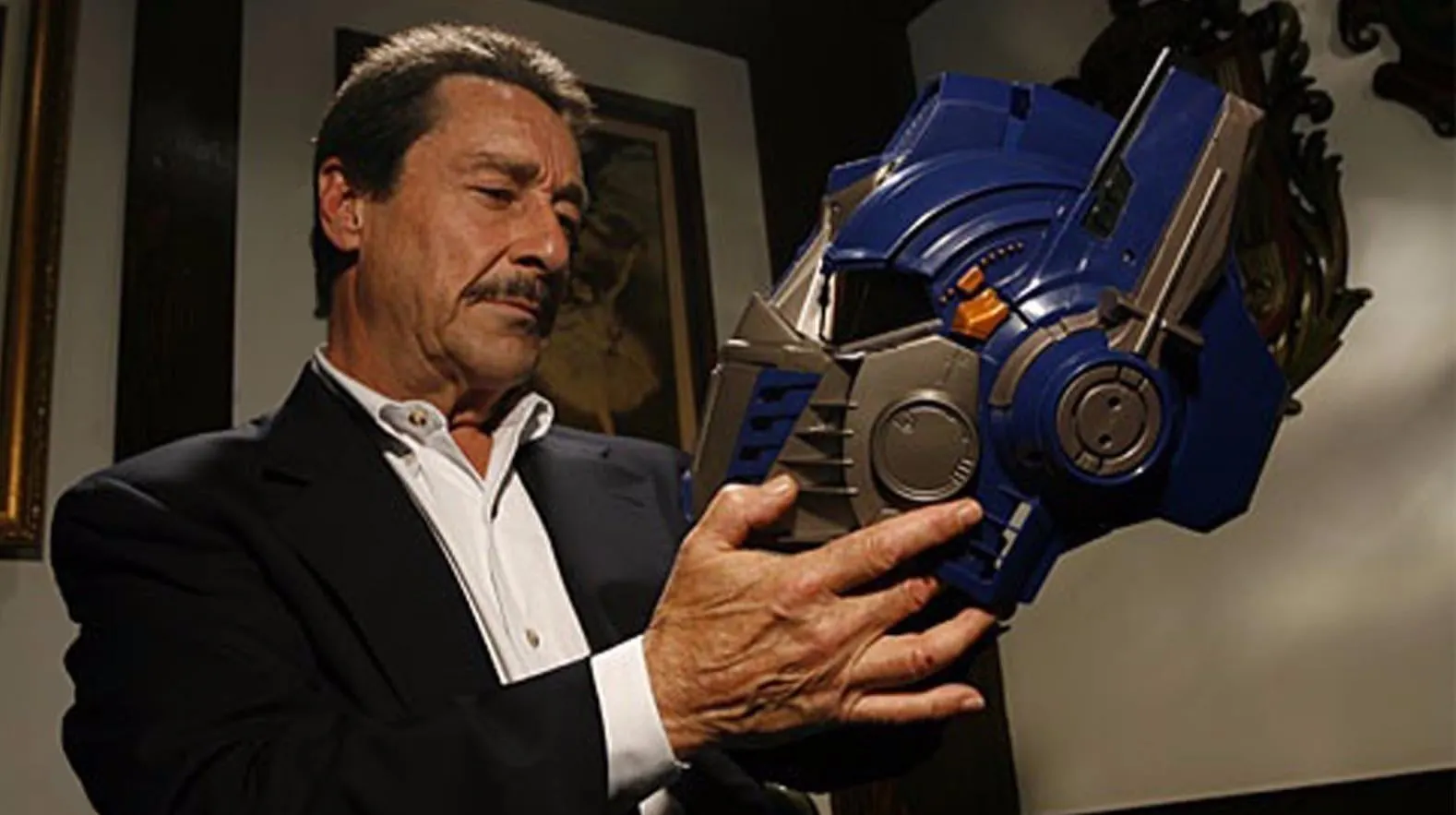
What Peter Cullen, best known for his role as Optimus Prime, meant to me.

The voice stopped on Wednesday.
That is the sentence I have been trying not to write all morning.
Peter Cullen died at eighty-five, at home in Los Angeles, with his family around him. I found out this morning standing in my kitchen with my phone in my hand. I read the words once. Then again. Then I set the phone face down on the counter and stood there for a while without doing anything at all.
I never met Peter Cullen. He never knew my name. And I have spent most of my life trying to sound like him.
At first, I mean that literally.
When I was a boy, I would lower my chin and reach down into a part of my chest that had not been built yet and try to find that voice. Autobots, roll out.Again. Lower. Slower. I would hear myself miss it and try again.
I thought the secret was the bass. It took me most of my life to understand that the secret was the gentleness.
There was an hour in the middle of the afternoon, in the years when I was small, that belonged entirely to me. The light in the room came from one direction. I sat closer to the television than anyone would have permitted if anyone had been watching, close enough that the picture came apart into its colors. There was usually a toy or several in my hands with paint already worn down at the joints from being folded and unfolded a thousand times.
The folding was the miracle. A thing became another thing and then came back again without losing itself. But what I remember with my whole body is the moment the noise of the show would settle and that voice would come in over the top of everything.
Low.
Unhurried.
Warm somewhere beneath the metal.
Optimus Prime never seemed to be performing strength. He simply possessed it. He did not need the room to become smaller so that he could become larger inside it. He could command an army without sounding as though he needed the army to know he was in command. And somehow, impossibly, the voice coming out of a forty-foot robot made a child feel safe.
That mattered to me. And, 40 years later, it still does.
There are things children understand long before they have language for them. I understood that this was what authority was supposed to sound like. I understood that power did not have to arrive angry. I understood that the strongest person in the room might also be the person speaking most carefully. He never made me feel small, or stupid, or like something to be gotten through. He spoke to children as though children were people whose understanding was worth the trouble of earning.
I do not know if you have any idea what that is worth to a boy sitting on a floor by himself at three-thirty in the afternoon. I can tell you the receipt is still in my chest.
Transformers had robots and jets and cassette tapes and impossible machines that folded themselves into other impossible machines. I loved all of it. But I became a fan because of him.
The toys gave me something to play with.
The stories gave me something beyond imagination to dream about.
Peter Cullen gave me someone to believe.
The story of how he found that voice has been told so many times that it has become part of the mythology now.
In 1984, Peter was living with his older brother Larry. Larry Cullen had been a Marine Corps captain in Vietnam. He had come home decorated with a Bronze Star and two Purple Hearts and whatever else a person brings home from a place like that which cannot be pinned to a uniform. Peter needed their car because he had an audition. Larry asked what for.
A truck.
That was funny. Then Peter explained that the truck was supposed to be a leader. A hero. And Larry stopped laughing.
He told his younger brother not to give them the Hollywood version. No puffed chest. No manufactured toughness. No yelling because yelling is what weak men sometimes mistake for command.
Be sincere. Be honest. Be respectful.
And then came the sentence that would somehow travel from one brother to another, across a casting booth, through a television transmitter, into millions of homes and eventually into the moral imagination of a boy sitting on a carpet somewhere.
Be strong enough to be gentle.
Peter drove to the audition with Larry in his ears. When the microphone came on, Larry came out.
“My name is Optimus Prime.”
That was it. A man imitating his brother. A brother remembering what heroism sounded like after the war. A truck.
And somehow the whole thing became scripture. I have thought about that car more than is reasonable for a grown man. Everything I received came through it. The voice I spent my childhood trying to imitate was not invented in a recording booth. It had already lived a life. It had gone to war. It had seen things. It had come home quieter.
Larry gave something to Peter. Peter gave it to Optimus.
Optimus gave it to us.
And some of us have been carrying it around ever since.
I always tried to sound like him.
As a child, sounding like Optimus meant dropping my voice as low as I could get it. As I got older, I began to understand that the sound came from someplace else. It was in the pause. The patience. The strange absence of ego. Optimus could be the most powerful person in the scene and somehow never seem especially interested in the fact.
Even his great command was an invitation.
Autobots, roll out!
Not follow me. Not watch me. Not look what I can do.
There was somewhere to go. Something needed doing. Come with me. That was leadership.
Before I ever heard Peter Cullen say the words aloud, I knew another sentence from the little biography printed on the back of the toy packaging:
Freedom is the right of all sentient beings.
I accepted this as a law of the universe. Sure, there were stronger Transformers. Faster ones. Smarter ones. Cooler ones, depending on how seriously you took playground arguments in the mid 80s.
But Optimus knew what strength was for.
He fought because something smaller than him was in danger. He stood between. He absorbed the hit. He believed, often beyond all available evidence, that people could become better than they currently were.
At one point he looks at humanity, this ridiculous young species that can barely stop hurting itself long enough to notice the universe unfolding around it, and decides there is goodness here worth protecting. I took that personally, then and still do now. I admit there’s something almost embarrassing about admitting how much moral instruction I received from a cartoon designed to sell toys.
Then I remember the voice. And I am not embarrassed at all.
Heroes come from wherever children can find them.
Mine happened to turn into a truck.
They killed that truck. If you were there in 1986, or watching the VHS release years after… you remember.
The room. Where you were sitting.Knowing something was wrong before you understood exactly what. He had been hurt before, sure — that was part of the bargain of 30 minute cartoons. Somebody would patch him up, Ratchet or Wheeljack would fix him, he would triumph over Megatron. The next episode would begin.
Except this time they carried him into a room. This time everybody stood around the bed. This time the color started leaving his body. Slowly. Cruellyslow.
Slowly enough that every child watching understood that the people making the movie were not going to save us from this. Optimus told the people gathered around him not to grieve. An impossible instruction.
He passed the Matrix to someone who did not believe himself worthy of it and told him, in essence, that worthiness had never been the requirement. Someday somebody would rise from the ranks. Someday the darkest hour would come. Someday the thing you had been carrying without understanding why would be needed. And then the voice stopped.
That was the first funeral I ever attended.
I had never watched anyone die. I sat there while the person who had been talking me through my afternoons stopped talking, and afterward I could not have explained to any adult in my life what had happened to me or why my face was doing what it was doing.
Decades later, I have watched men with mortgages and gray hair and children of their own become eight years old again while describing that scene. We laugh about it because that is what men sometimes do when the alternative is admitting that something got all the way inside. But it did. It got all the way inside.
For years I thought that scene was teaching me how to lose Optimus Prime. This morning I understood that it had been waiting there for forty years to teach me how to lose Peter Cullen.
Of course, that truck came back. Optimus always came back. And eventually Peter did too.
In 2007, when that impossible truck stood up on a movie screen and that voice came out again, something happened in theaters full of adults that had nothing to do with nostalgia.
We knew him. Before the face was finished moving, we knew him. Twenty years of absence disappeared.
For a moment there was no mortgage, no career, no middle age waiting somewhere down the road. There was only that sound and the instantaneous recognition that the person who had once made the universe feel ordered had returned.
The movies changed. The designs changed. The continuity changed.
Transformers kept becoming something else and coming back again without any part of it being lost.
And there he was.
Peter Cullen became the thread.
When Transformers: Prime arrived in 2010, the voice was older.
That mattered.
There are some things an actor cannot manufacture. Time has to put them there. There was more air around the words now. More weariness. More knowledge of what command costs the person doing it.
And then Larry died. The brother whose voice had gone into the booth in 1984 was buried at Arlington with military honors.
Peter kept going to work. Kept walking into dark rooms. Kept standing in front of microphones. Kept reaching down into himself and bringing Larry back.
Think about that for a moment.
Most of us who lose somebody get photographs. Maybe voicemails we cannot delete. Clothes that stop smelling like the person after a while no matter how carefully we protect them. A box somewhere we cannot quite bring ourselves to open. I have my father’s rings, his letters, videos of us talking with Kingsley barking somewhere nearby.
I understand Peter’s ritual differently than I would have understood it a few years ago. I know something now about what happens after a father becomes a voice you can no longer call and can still hear. The dead go quiet slowly and unevenly, and they go on speaking out of objects, out of the rings, out of the handwriting, out of a video where he is talking about nothing in particular and Kingsley is barking somewhere off the frame at nothing at all. And then one ordinary afternoon you open your mouth in an ordinary conversation and the cadence that comes out belongs to him, his timing, his particular way of arriving at the end of a thought, and you understand that you have been carrying it around this entire time without ever having been consulted, and you have to stop in the middle of your own sentence and let it finish passing through you.
That is the version that arrives on its own, without permission, when it feels like it.
Peter Cullen went and got his on purpose.
Peter Cullen had a job that required him to become his dead brother out loud.
Again.
Again.
Again.
And somewhere, children were listening.
Optimus reached the end of another story. He carried the source of his world’s life back where it belonged, knowing what it would cost him. He told the family gathered around him not to mourn. He called what was coming another transformation.
And then, standing at the edge of himself, he returned to the same promise he had given us twenty-seven years earlier.
He ended twice on the same sentence.
I do not think I will ever get over that.

I do not know what Transformers looks like without Peter Cullen. I have tried to imagine it today. I cannot.
Of course there will be more Transformers. There should be. There have been other Optimus Primes, other voices, other universes, other interpretations. Some of them have been wonderful.
But that is not quite what I mean.
For me, Transformers has never existed without the possibility of that voice somewhere inside it. Even when Peter was not playing Optimus, I was listening for the thing he established.
The moral frequency. The calm. The expectation that eventually, when everything became unbearable, somebody would stand up and know what needed to be done.
Peter Cullen did not merely voice Optimus Prime. For me, his voice was the sound Optimus Prime made when the character was true.
I know that because I write these characters .
I have spent years of my adult life making stories inside the world I first entered sitting on that floor.
And whenever I put Optimus Prime on a page, albeit unofficially, I hear Peter before I see anything.
I hear where the sentence breathes. I hear the patience before the command. I hear how disappointed he could sound without ever becoming cruel. I hear the weight that had to be present before Optimus would allow himself to speak.
Sometimes I rewrite a line because I cannot hear Peter Cullen saying it.
That is the test.
It has always been the test.
There is a particular responsibility in writing a character whose voice was already living in your head before you understood that you wanted to be a writer at all.
I can type OPTIMUS PRIME above a line of dialogue. I can decide what he says next, and what he declines to say, and what he carries out of the room still unsaid. That is an enormous permission, and I have never once handled it casually, because the instant that name goes on the page there is an eight-year-old somewhere inside me who sits up on the carpet and asks the only question he has ever cared about.
Does he sound like him?
He is asking about something well past the register. He wants to know whether the patience is in there. Whether the sentence breathes where Peter would have allowed it to breathe. Whether there is kindness underneath the command, whether the weight has been earned before the first word, whether this Optimus understands that being the strongest thing standing in the room is precisely the reason he owes every other thing in it his care.
That boy is a harder editor than anyone I have ever worked with, and he is completely incorruptible, and he has never once let me pass off my own voice as the one he is listening for. When I cannot hear Peter saying it, the line goes back, however fine it looked to me an hour earlier.
I became a writer because first I had been a listener.
All these years later, I am still trying to sound like him. Only now I understand that I am not trying to find the register; I am trying to find the man inside it.

So.
My robot dad.
I used to say that as a joke. Somewhere along the way the joke went out of it. A father, if we are lucky, becomes a voice we install inside ourselves and go on consulting long after we have stopped needing someone to tell us when to come home.
What should I do?
What kind of man am I trying to be?
What does strength require here?
What is worth defending?
Who needs me to stand between?
There have been rooms. Rooms where I held the title and the agenda and the last word, where I had been wronged or had persuaded myself that I was, where every instrument of escalation was sitting on the table in front of me and not one person in that building would have thought less of me for reaching. I know precisely what my voice does when I let it off the leash. I have felt a room contract around it. There is a pleasure in that contraction which I have learned to distrust entirely, because I have watched what it does to the face of a person who came in intending to tell me something true and left having quietly decided against it.
And in the half second before I speak, the old instruction arrives, in the register it has always arrived in, low and unhurried and warm somewhere beneath the metal.
Lower your voice. Make the room safer than you found it. You are the largest thing standing in here, and that is the entire reason you owe these people your restraint.
The voice I installed during the years when the installing gets done belonged to a Canadian actor doing a loving impression of his older brother. That sounds ridiculous when you write it down. It also happens to be true.
I never stopped working in his house. I have written stories about the wreckage after the battles. About the quiet between them. About what duty costs. About what happens to people who survive the heroic moment and have to wake up the following morning.
I have spent absurd amounts of my adult life thinking about Autobots and Decepticons and Cybertron and why anybody should care. I have a room dedicated in my house to these silly things. I have lifelong friends I met on Usenet because forty years ago they heard something in them too.
I know now what I had no way of knowing then, which is that the floor was crowded.
There were millions of us. Different houses, different carpets, different arrangements of adults in the other rooms, different and specific silences that we each had our own reasons for wanting filled. Some of us were waiting for somebody to come home. Some of us were relieved that nobody was coming. We had entirely separate reasons for needing him and we did not know one another existed, and at three-thirty in the afternoon the same voice came through every one of those televisions and told all of us the same thing about what courage sounds like when it is genuine.
That is why the grief has this odd familial texture today. That is why my phone has been going since breakfast with men I have known for thirty years and men I have never once met in person, all of us saying the same six or seven inadequate words to each other, all of us surprised by how much it is costing us.
We were raised in the same house. We had the same robot dad.
And somewhere within every house is the same thing I heard before I was old enough to explain it:
Strength has obligations.
Power is supposed to protect.
Leadership is not possession.
Freedom belongs to everybody.
Be gentle.
I bought toys. Made fanfiction. Commissioned art. Wrote dialogue until three in the morning. Argued about panels and colors and whether Optimus would say this word or that one. A grown man with a doctorate and a career, still sitting on the floor in some essential part of himself, still holding the toy, still listening.
That is what a good father actually gets when the love holds.
The child keeps showing up to the family business.
Both brothers are gone now.
Larry is under the grass at Arlington.
Peter died at home on Wednesday, surrounded by the people who actually knew the man behind the voice.
His family asked us not merely to remember him. They asked us to do something with what he gave us: serve the people around us. Lead with compassion. Integrity. Loyalty.
And remember the six words.
Be strong enough to be gentle.
Of course they did.
What else could the final instruction possibly have been?
I keep thinking about the fact that somewhere, right now, a child is going to hear Peter Cullen for the first time. Maybe this afternoon. Maybe forty years from now. The child will not know that the man speaking is gone.
He will only know the voice.
He will sit too close to whatever screens look like then. He will hold some version of Optimus Prime in his hands. He will hear that impossible machine speak with patience and warmth and absolute conviction.
And something will be installed.
Maybe the child will lower his voice afterward and try to imitate him. Maybe he will think he is practicing a sound. Maybe it will take him forty years to understand what he was really practicing.
Maybe that was the miracle the entire time, and I was holding it in my hands on that floor years before I could have told you what I was looking at. A thing becomes another thing and comes back again without losing itself.
A Marine comes home from Vietnam and becomes a piece of advice given in a driveway over a borrowed car. The advice becomes a voice in a booth in Burbank. The voice becomes a robot, and the robot becomes a hero, and the hero becomes something a child folds up small and carries into a life nobody has described to him yet, and the child becomes a man who will spend that life unfolding it again and again to see what is still inside. Every one of those was a transformation. Every one of them cost the previous thing its shape and took nothing at all from its substance.
Another transformation. He told us what it was. He told us twice.
The voice stopped on Wednesday. The instruction did not.
Thank you, Peter. For every afternoon. For every return. For making a red truck feel safer than most of the adults in the room. For giving a little boy a definition of heroism before he knew he needed one. For giving that boy a world he would never completely leave. For teaching him that strength could lower its voice. For giving him something worth trying to sound like.
I heard you.
I am still trying.
Til all are one.

Leave a Reply